
Who We Are & What We Do

Data2Action Oregon (D2A OR) is part of and supported by the NIH HEAL Initiative® as part of the HEAL Data2Action Program (R33 DA059163).
Our goal is to increase the availability of user-friendly, relevant data to inform local decisions and policies that aim to connect individuals to a continuum of substance use services and prevent overdoses. We are not trying to evaluate the quality of services for any county.
We will achieve this goal by:
Conducting a co-design process with local actors across Oregon to create data products — ways to share locally-relevant data back with local actors
Sharing data products with all Oregon counties in a rigorous trial
When We’re Conducting Each Phase
PHASE 1
Fall 2023 – Fall 2024
Clarified project goals
Secured funding for Phase 2
PHASE 2
Fall 2024 – Summer 2026
Held county-wide conversations about community priorities and decision-making support preferences
Collected data to evaluate project
PHASE 3
Summer 2026 – Fall 2028
CURRENT PHASE
Collect data to evaluate project
Distribute data products to all Oregon counties
Check out our current participation opportunities!
Where You Can Find Us
Upcoming Conferences & Events
Association for Addiction Health Services Research Conference | October 5–7, 2026 | Salt Lake City, UT
Oregon Public Health Association 82nd Annual Conference and Meeting | October 21–22, 2026 | Salem, OR
How Our Project Works
Our project is focused on local decision-makers and their perspectives. Decision-makers include individuals from front-line work to administrative and policy-making levels across five perspectives: public health (e.g., public health departments); behavioral health (e.g., substance use organizations, mental health organizations, mental health departments), payers (e.g., insurers, elected officials), first responders (e.g., fire, law enforcement, EMS), and advocacy (e.g., local mental health and drug policy committees).

Collaboration
This project will incorporate the perspectives, data, and suggestions of representatives from five perspectives. This will happen through group discussions, focus groups, surveys, and written feedback.

Co-Design Process
A co-design process will be used to co-create data products that make prioritized data available to local decision-makers.

Evaluation and Dissemination Process
We will study the public health and service system impacts of our data products with a rigorous trial. We plan to learn more about data-driven decision making, system collaborations, and which data points are most valuable to local decision-makers.
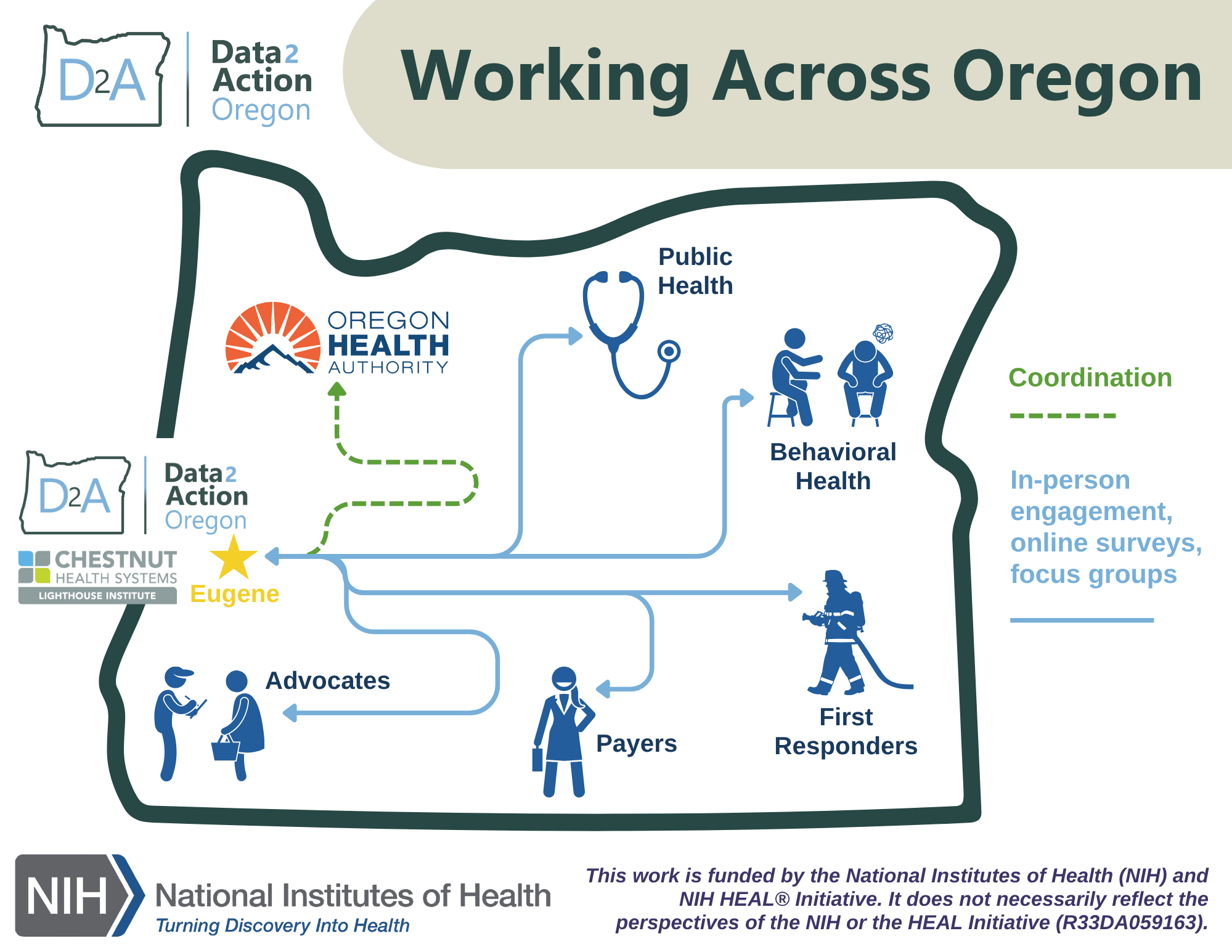
This work is in collaboration with numerous community partners, research consultants, and research colleagues at the University of California-Los Angeles (UCLA). We thank them for their valuable contributions to the project!
Acknowledgements
Erika L. Crable (Site Primary Investigator, UCLA)
Elle Pope (Postdoctoral Scholar, UCLA)
Y. Vivian Byeon (Postdoctoral Scholar, UCLA)
Gregory Aarons (Consultant)